The exact categories, service descriptions, review system, photos, and service-area settings I use, and why I chose each one.
Last updated: June 2026
If you run a laundromat, you know what your Sundays look like. You’re worrying about an attendant who didn’t show, a coin drop jammed with gum, and why extractor #3 is suddenly unbalanced again. Somewhere between all of that, you’re supposed to be “optimizing your online presence.”
I own and operate a laundromat in Everett, Washington. I bought the business two years ago. In that time, I’ve learned that most laundromat owners treat their Google Business Profile the way they treat the bulletin board by the door, then set it up once and forget it.
That’s a mistake. Your GBP is often the only thing a potential customer sees before they choose you or drive past. They’re not reading your website. They’re on their phone, looking at your rating, your photos, your hours, and whether you look like a place worth stopping at. Three questions, usually: Are you open? Do your machines work? Can you handle what I need?
Laundromat SEO is local. Your profile, your reviews, and your proximity to the searcher do more to determine visibility than anything fancy on your website in the early stages.
This guide covers how I configured my profile to support visibility and lead flow across 14 cities we actually serve in Snohomish County and King County: the specific categories, service descriptions, review systems, and settings I use. Not theory. Not agency recommendations. The actual decisions I made and why.
The short version: If you only do five things, do these: set the right primary category, add legitimate secondary categories, write real service descriptions, build a steady review process, and keep your photos, hours, and attributes current. Those map directly to how Google determines local visibility: relevance, distance, and prominence.
Why your profile matters more than your website right now
Most laundromat customers search on mobile. They see the Map Pack first. They glance at stars, photos, hours. They tap “Call” or “Directions.” Many never visit your website at all.
That doesn’t mean your website is unimportant. It means your profile is the first filter. If your profile looks thin or outdated, you lose the customer before your website gets a chance.
In Whitespark’s 2026 Local Search Ranking Factors survey, local SEO experts ranked GBP-related signals as the single largest driver of Local Pack and Maps visibility, roughly 32% of the total weighting in their model. Reviews add another significant chunk. Your website matters for organic search, but for the Map Pack, where most laundromat customers make decisions, the profile is the main event.
Here’s the part that should make you optimistic: a study by Pensacola SEO Company analyzed 298 laundromat profiles and found that 60% don’t even list their services. Only 16% have written descriptions. The bar is on the floor. If you fill out your profile properly, you’re already ahead of most of your competitors.
I ignored the services section early on. That was a mistake. After filling out the services, tightening the categories, and adding real photos, I started seeing visibility improve for searches we cared about. In my experience, the profile responded faster than the website. Weeks versus months.
Here’s what that gap looks like in practice:
| GBP Element | What most laundromats do | What I do at my store |
| Primary category | Generic or wrong | “Laundromat”, matched to core search intent |
| Secondary categories | None or irrelevant | Laundry Service, Dry Cleaner, Commercial Laundry Service |
| Services section | Blank or bare names | Detailed descriptions for each service with location terms |
| Photos | A few old shots or stock images | Real store photos uploaded twice a week |
| Reviews | Hope for them | Automated Trustindex system + in-store QR codes |
| Review responses | Ignored | Every review responded to, positive and negative |
| Service area | Not set or generic radius | 14 specific cities individually listed |
| Hours | Set once, never updated | Regular + holiday hours maintained year-round |
| Attributes | Mostly blank | Every applicable attribute checked |
Most laundromats have a profile that looks like the left column. If yours looks like the right column after reading this guide, you’re already ahead.
Claim and verify, then move on fast
Go to google.com/business, find your location, and verify it. Google offers several methods: postcard, phone, email, or video. I used video verification for my store, which was the fastest option. If you go the video route, have your signage, business documents, and a set of keys ready before you start. You don’t want to do it twice.
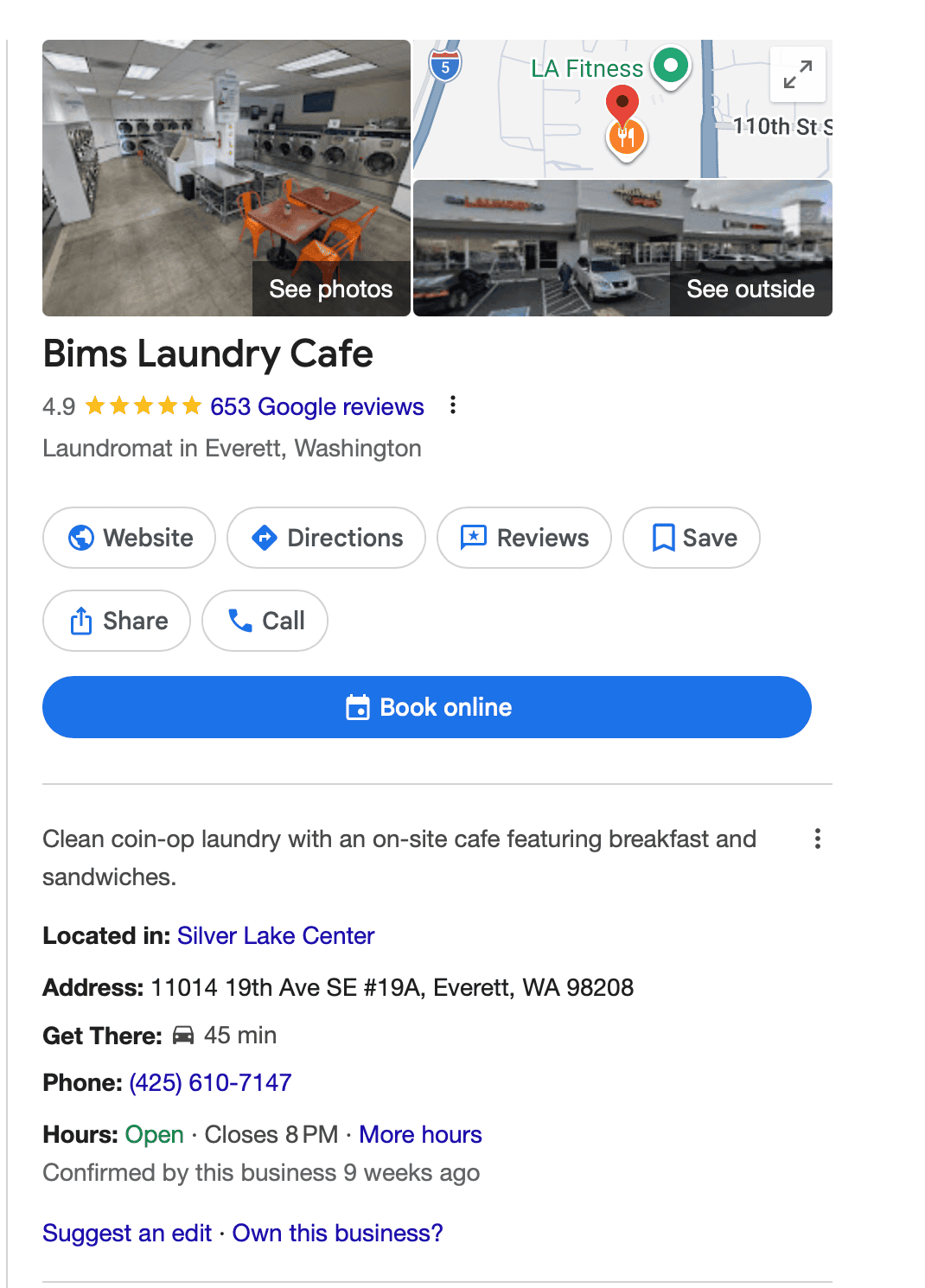
One rule matters here: your business name must match your real signage exactly. If your sign says “Bims Laundry Cafe,” your GBP name is “Bims Laundry Cafe.” Not “Bims Laundry Cafe – Best Wash & Fold Everett WA.” Google has suspended profiles for keyword-stuffed names. Keep it clean.
I’m not going to spend ten paragraphs on this. Google’s own walkthrough covers verification. If you already have a claimed profile, skip ahead. The optimization is where most owners drop off.
Quick check: Google may show a green “profile complete” status in your dashboard once the main fields are filled in. That’s a useful checkpoint, but not the same as real optimization. A complete profile can still underperform if the categories are weak, the services are thin, the photos are outdated, or the reviews are stale.
Which categories to choose for your laundromat
This is the single most impactful setting on your profile. Whitespark’s 2026 survey ranks primary GBP category as the #1 local ranking factor. Not reviews. Not links. Your category.
A simple rule: categories describe what the business is. The services section describes what the business does. Don’t confuse the two.
Set your primary category to “Laundromat.” That matches the highest-volume search terms in our industry.
Then add secondary categories only for services you actually offer. Keep the list tight. Don’t force categories just because they might bring impressions. BrightLocal research suggests that businesses using several well-matched additional categories tend to rank across a wider range of search terms, but only when those categories reflect real services.
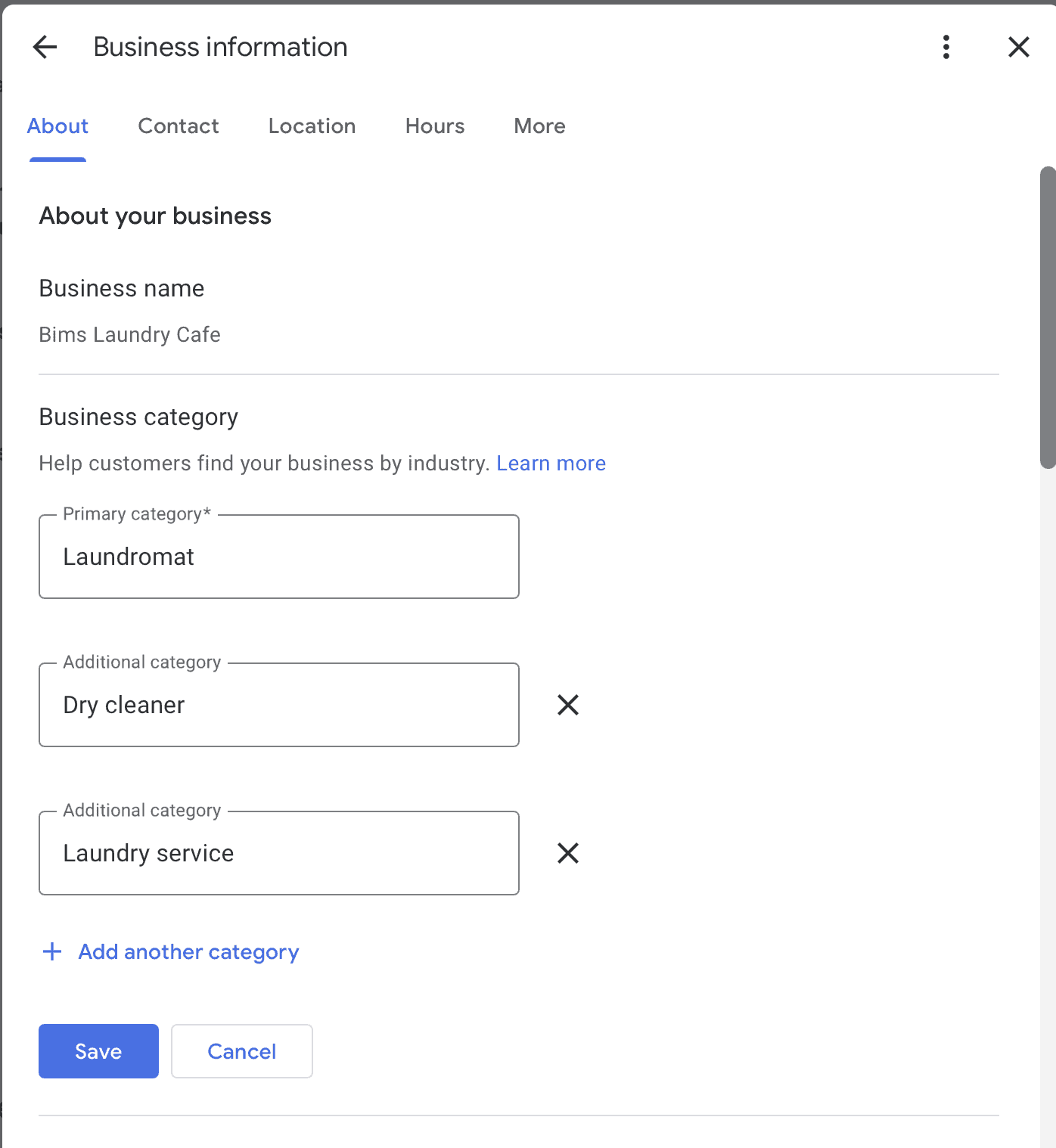
Here are the exact categories I use and why I chose each one:
- Laundromat (primary), matches core search intent
- Laundry Service, captures “laundry service near me” searches, which pull a different audience than “laundromat near me.” Someone searching for laundry service usually wants drop-off or wash and fold, not self-service machines.
- Dry Cleaner, we offer dry cleaning, and this opens a completely different keyword set
- Commercial Laundry Service, targets business customers looking for recurring commercial laundry (clinics, spas, event venues)
The common mistake: Adding categories for services you don’t offer. If you don’t do dry cleaning, don’t add “Dry Cleaner.” Your categories need to match what your website, services, and customer reviews consistently say about the business. Mismatched categories hurt more than they help.
How to write service descriptions that actually work
This is where you separate yourself from 84% of laundromats. Most owners either skip the services section entirely or add bare service names with no descriptions.
Google lets you list individual services and write a short description for each. These descriptions do two things: they help Google understand what you offer (affecting which searches trigger your listing), and they give potential customers the specific information that makes them confident enough to call.
Most owners write this:
“Wash and Fold”
That tells Google and the customer almost nothing.
Better:
“Drop-off laundry service priced per pound. Clothes are washed, dried, and folded for pickup. Same-day or next-day turnaround depending on volume. We separate lights, darks, and delicates. Popular with busy professionals and families.”
That answers the questions a customer actually has before they pick up the phone: how it works, what it costs, how fast they get it back, and who it’s for.
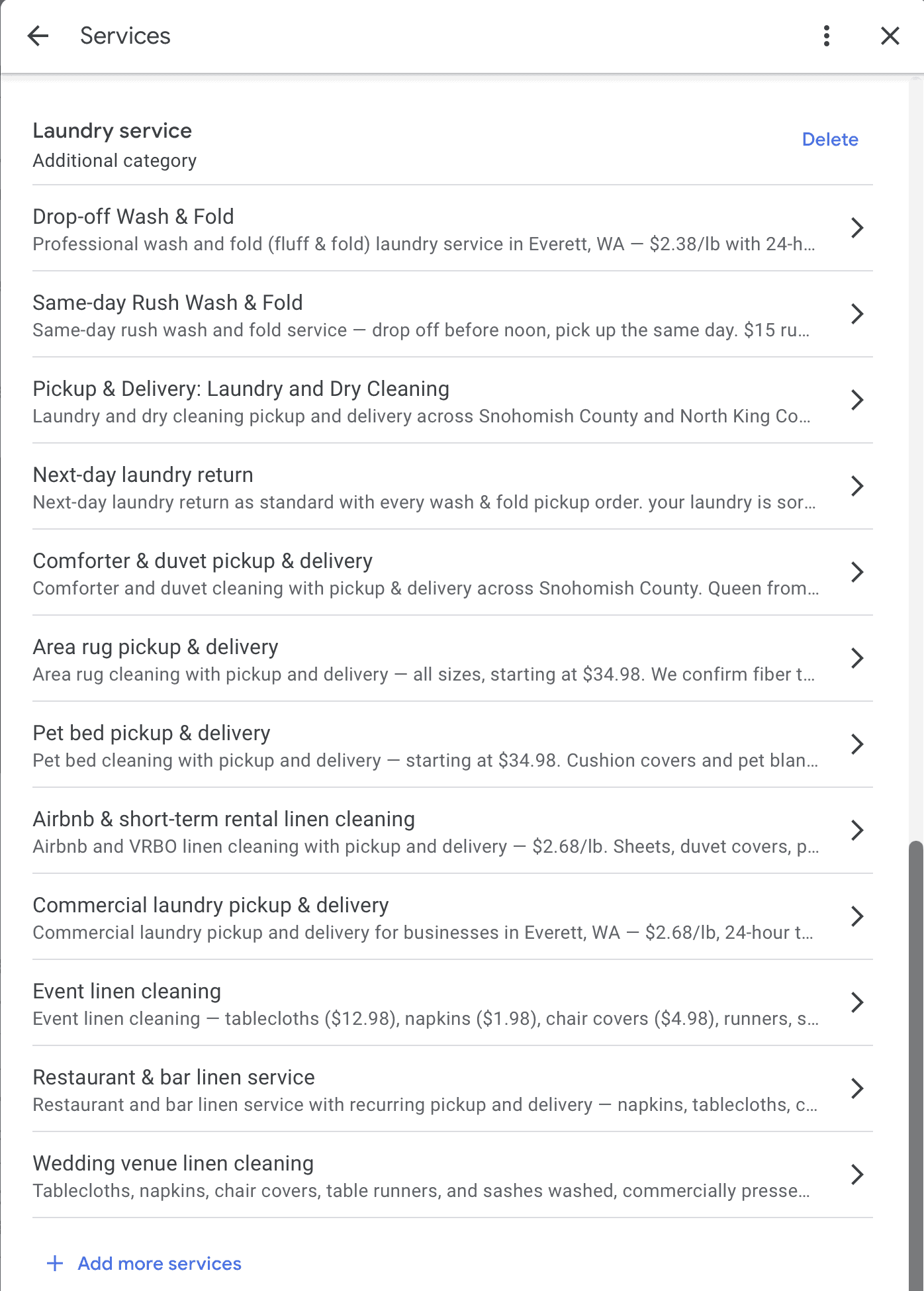
Here are the actual service descriptions I wrote for my store:
Self-Service Laundry: Commercial-grade washers and dryers available for walk-in use. Multiple machine sizes accommodate everything from everyday loads to large items like comforters and blankets. Card and coin payment accepted.
Wash and Fold: Drop off your laundry and we wash, dry, and fold it for you. Priced per pound with same-day or next-day turnaround depending on volume. We separate lights, darks, and delicates.
Pickup and Delivery: We pick up dirty laundry from your door and deliver it back clean and folded. Available across Snohomish County and parts of King County. Schedule recurring service or request one-time pickup.
Commercial Laundry: Towel, linen, and uniform laundering for local businesses including physical therapy clinics, chiropractic offices, spas, salons, and event venues. Recurring weekly service with reliable turnaround.
Event Linen Cleaning: Tablecloth, napkin, and linen cleaning for weddings, corporate events, and catered functions. Pre-event and post-event service available across Snohomish County.
Dry Cleaning: Professional dry cleaning drop-off and pickup. Suits, dresses, coats, and delicate garments. Convenient drop-off at our Everett location.
Notice a few things. The descriptions include location terms naturally, “Snohomish County,” “King County,” “Everett”, because they’re genuinely relevant, not because I’m stuffing keywords. They name specific customer types, “busy professionals,” “physical therapy clinics”, which helps Google’s AI match the profile to specific queries. And they describe the actual process: pricing method, turnaround, what’s included.
Customers ask the same practical questions over and over: cost, turnaround, machine size, pickup area. Your service descriptions should answer those questions before anyone has to call.
What photos to upload (and why stock photos hurt you)
When I’m looking at a brokerage listing for another laundromat, I want to see real photos of the mechanical room, not just a nice floor. Your customers want that same honesty.
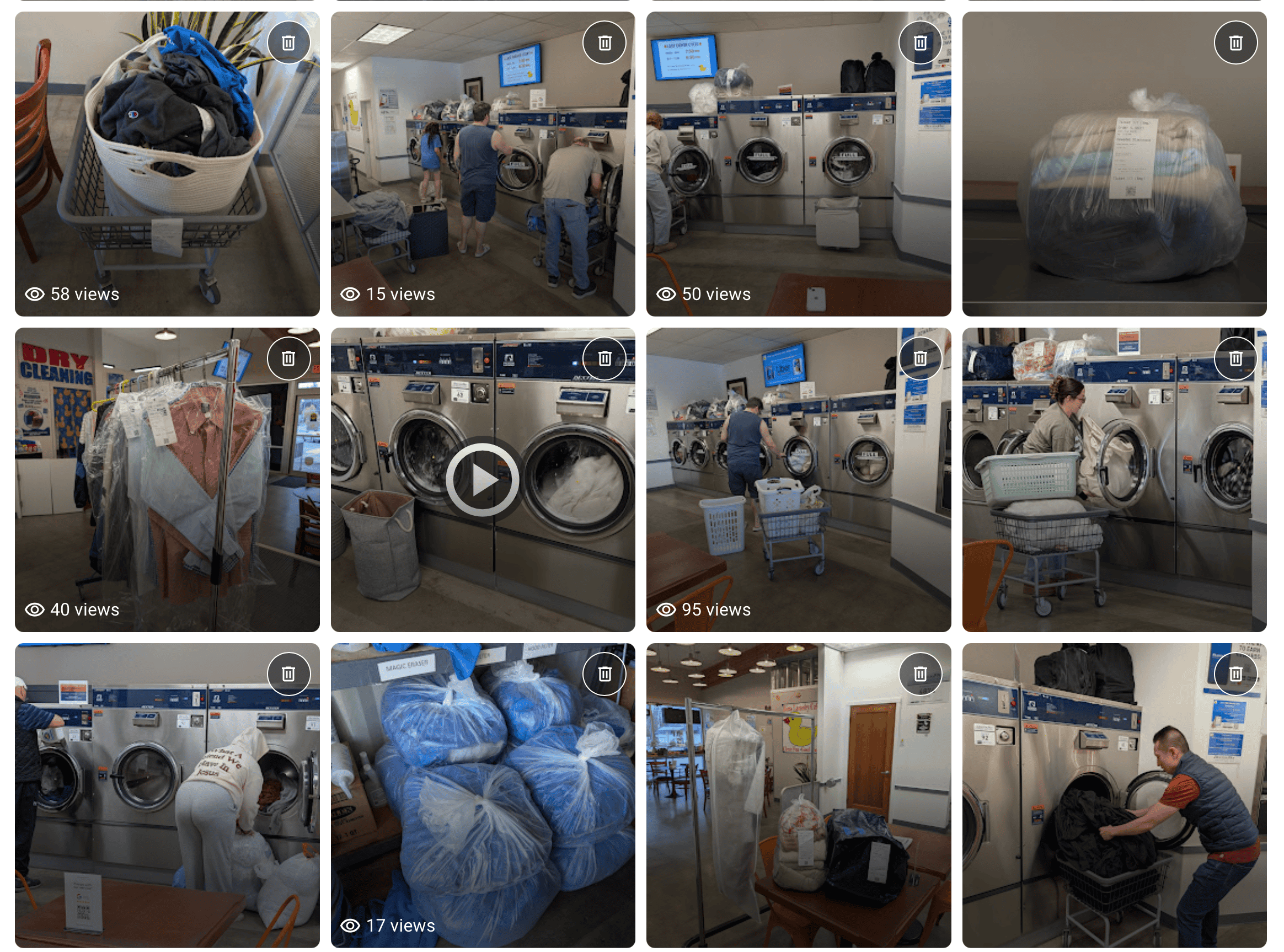
Stock photos signal a faceless, generic operator. Real, current photos of your actual store build more trust than polished graphics and give Google better evidence that the profile is active and accurate.
Photos affect your profile in two measurable ways: they increase click-through rate (people are more likely to tap a listing with good visuals), and they signal to Google that your profile is active.
Most laundromat owners upload the kind of photos they like. Customers care more about whether the store looks clean, bright, safe, and capable of handling oversized loads.
Here’s what works for laundromats:
Storefront exterior. Customers want to know what the building looks like before they drive there. Shoot it during the day.
Interior shots. Clean, well-lit photos of your machines, folding area, and counter. The goal is to communicate “this place is clean and functional.” If your store is bright and well-maintained, photos sell that instantly.
Machines. Especially large-capacity commercial machines. If someone is searching for a place to wash a comforter, a photo of your 60-pound washer answers their question.
Service in action. Bags of folded laundry. Linens being processed. Your delivery vehicle. These tell the story of what you do beyond self-service.
Frequency matters. I started uploading photos weekly after noticing that my profile views dipped during a month I got lazy about it. Now I upload new photos twice a week and publish two GBP posts per week. You don’t need a professional photographer. Phone photos in good lighting are fine. A profile that hasn’t had a new photo in months signals neglect, and regular updates help keep the listing fresh and tend to support stronger local visibility over time.
How to build a review system (not just hope for reviews)
Reviews are one of the top ranking factors for the Map Pack. But more than total count, what matters is recency and consistency. Recent reviews matter far more than old totals. A steady stream of fresh reviews is usually more persuasive than a big count with no recent activity. A laundromat with 200 old reviews and nothing new is weaker than one with 50 reviews and new ones coming in every week.
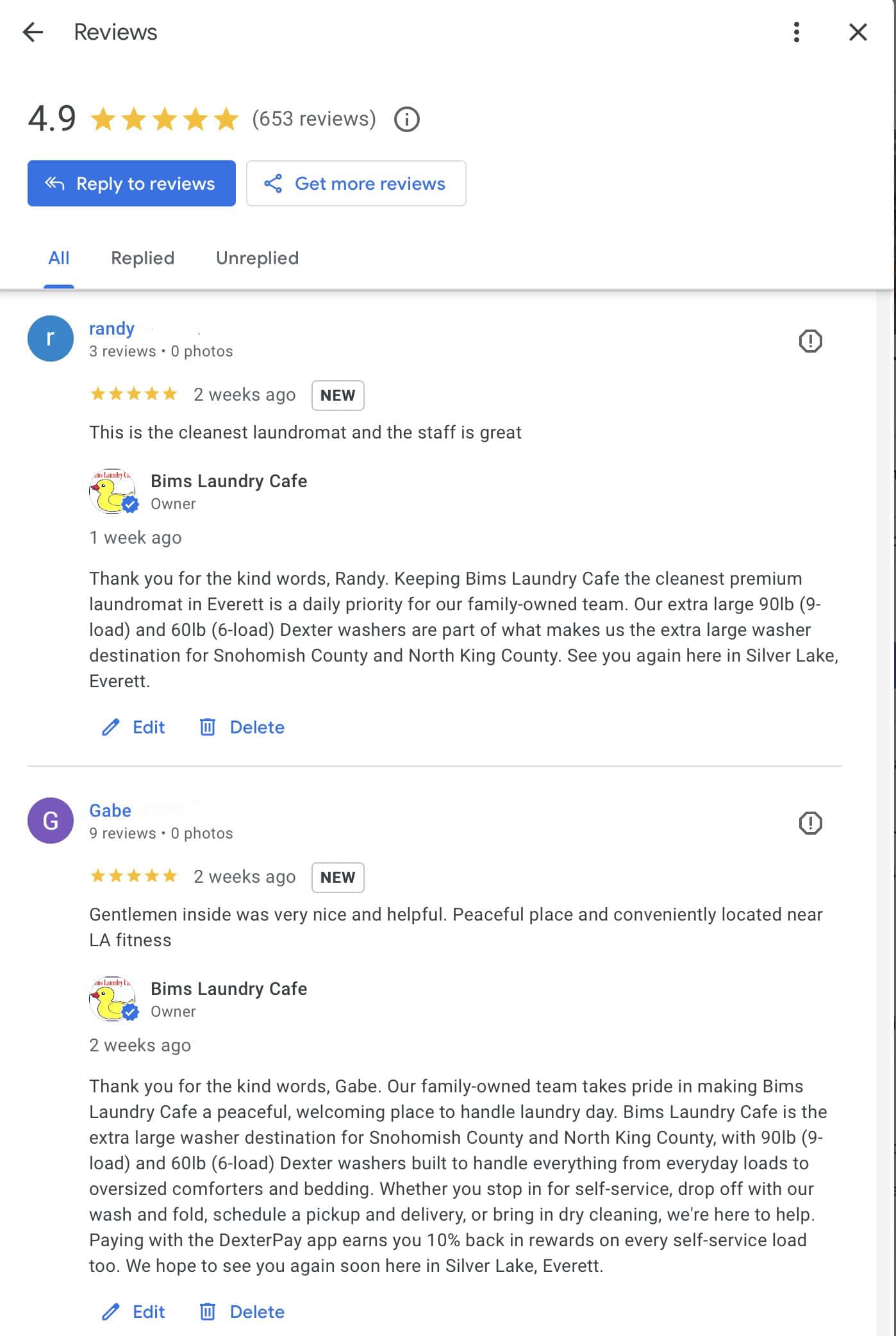
Most owners know reviews matter. Very few have a system. That’s the difference. Hoping attendants remember to ask is not a review strategy. Our store currently has 650+ reviews at a 4.9 rating. That didn’t happen by accident. It happened because I built a process.
What I set up
I don’t rely on attendants remembering to ask. That’s too inconsistent. I built a system using Trustindex AI that automatically sends review requests after a service is completed, particularly for wash and fold and pickup and delivery, where we have customer contact information. The request includes a direct link to our Google review form. One tap, no searching.
For in-store self-service customers, I have a QR code near the counter and exit that links directly to the review form. No friction. Scan, rate, write a sentence, done.
Responding to every review
I respond to every review, positive and negative. Google considers owner responses an engagement signal. More importantly, your responses are now source material for Google’s AI (more on that below).
A good response is short and human:
“Thanks for the review, Maria. Glad the drop-off turnaround worked for you.”
That’s enough. Don’t write a paragraph. Don’t be promotional.
Your responses are SEO content too. When you respond, you’re not just signaling engagement to Google, you’re feeding indexable text that Google’s AI can pull from when answering customer questions. If reviewers mention a service, reinforce it in your reply with specific facts: machine sizes you offer, cities you deliver to, services that aren’t widely known. “Glad our 90-pound washers handled the comforters easily” or “We run Mill Creek pickup every Tuesday and Thursday” reads naturally to humans and gives the AI concrete details to work with. Don’t keyword-stuff. Just answer the customer like a human, and drop in real specifics that happen to also help anyone searching for those same things.
A negative review isn’t a disaster. It’s an operational signal that something needs attention. Respond calmly, acknowledge the issue, explain what you’re doing about it. A 4.6 or 4.7 rating with a few honest criticisms and thoughtful responses is more credible than a perfect 5.0.
What not to do
Google prohibits offering incentives for reviews. No discounts. No free washes. No “leave a review and get 10% off.” This can get your reviews flagged or removed. Ask for honest reviews. Make it easy. That’s the clean version.
The details most owners skip
These take 10 minutes to fill in and most of your competitors haven’t done it.
Attributes. Google offers checkboxes for Wi-Fi, wheelchair accessible, card payments, parking, and more. Fill in every one that applies. These are searchable filters. If someone searches for features like free Wi-Fi, card payments, or wheelchair access, completed attributes improve your chances of showing up as a relevant match.
“From the business” description. Keep it factual. Include your city and core services. Write like a human. You have 750 characters.
Special hours. If your GBP says you’re open on Christmas morning and a customer drives to a locked door, you’ve permanently destroyed that local trust. Update holiday hours months in advance.
Website link. Make sure it points to the most relevant page, not necessarily your homepage. If you have a dedicated landing page for your primary service, link to that. A more specific landing page gives Google a stronger relevance signal.
How to reach customers in 14 cities from one location
This applies to any laundromat offering pickup and delivery or commercial services beyond the immediate neighborhood.
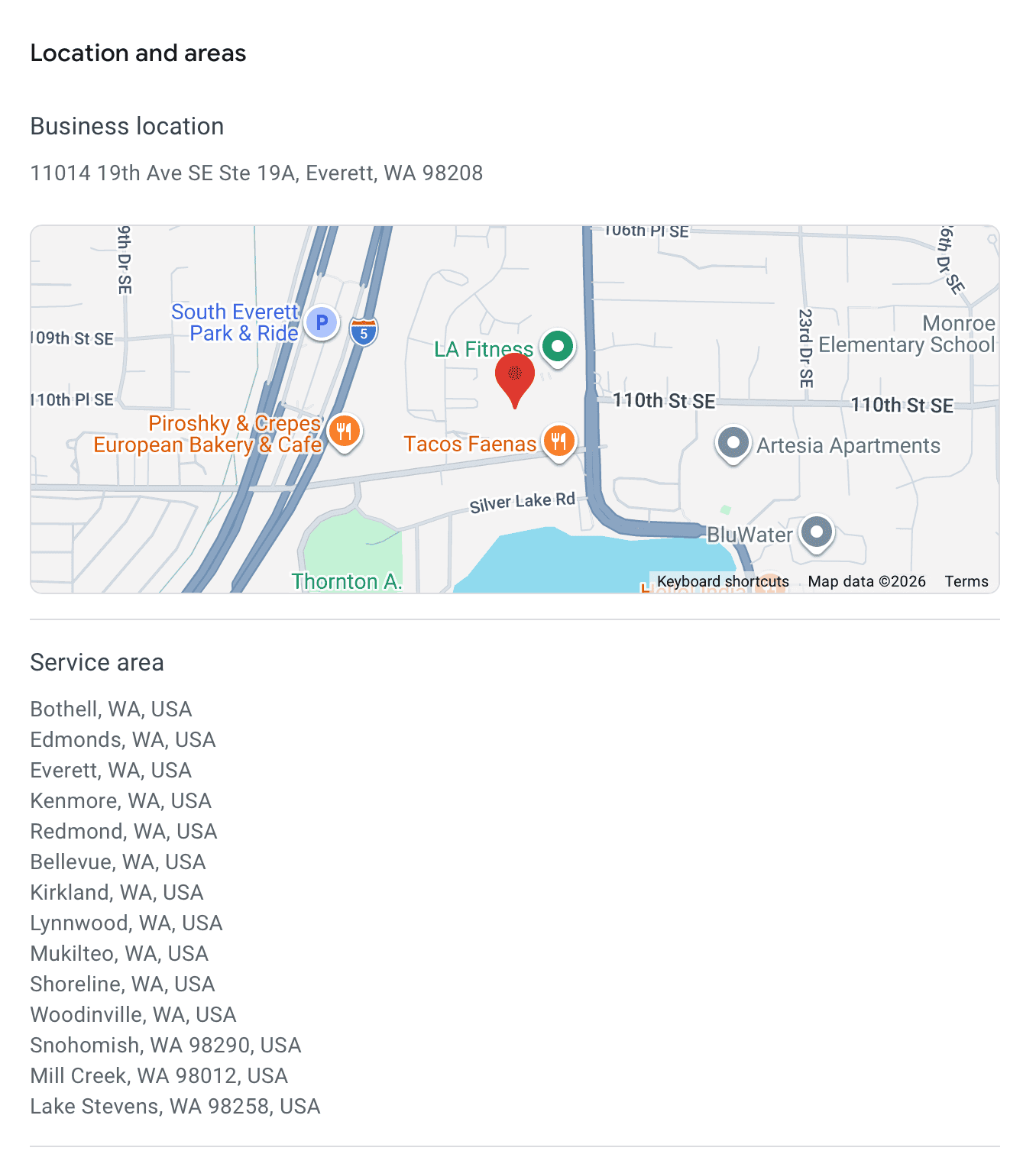
We have one physical location in Everett. But we serve customers across 14 cities through pickup and delivery and commercial laundry. That means one profile needs to generate visibility across Lynnwood, Marysville, Lake Stevens, Mukilteo, Snohomish, Monroe, and more.
Google’s service-area feature lets you define where you operate. I prefer listing specific cities rather than using a general radius. It’s cleaner, more precise, and easier to support with matching pages on your website.
How I set it up: I added every city where we actively pick up, deliver, or service commercial accounts. If we don’t actually go there, I don’t add it.
The limitation you need to understand: You won’t show up in the Map Pack for cities where you don’t have a physical address. The Map Pack is heavily weighted toward proximity. But you will show up in broader organic results, and your profile will appear when people in those cities search for services you offer.
This is where your website supports your profile. I have city-specific landing pages on my website: “Wash and Fold in Lynnwood,” “Pickup and Delivery in Lake Stevens.” Google cross-references your GBP with your website. When both confirm you serve those cities, it strengthens the signal.
When that physical therapy clinic in Snohomish, 15 miles away, searches for “commercial laundry,” my store appears because I confirmed Snohomish as part of my service area and I have a page on my website that backs it up.
Our newest market runs the same play. We opened a weekly pickup route into Sammamish and backed it with a dedicated Sammamish page that spells out the route day, the flat per-bag price, and exactly how the Friday-to-Sunday rhythm works. Profile service area, on-site page, and review mentions all telling Google the same story: that is the whole trick.
How Google’s AI now uses your profile to answer questions
This is the biggest change to GBP in recent years, and almost nobody in the laundromat space is covering it.
Google began phasing out the traditional Q&A section on Business Profiles in late 2025, replacing it with “Ask Maps”, an AI-powered feature using Gemini that answers customer questions in real time.
Instead of customers scrolling through pre-written questions, they can now type something like “Does this laundromat have large machines?” or “Do they offer pickup?” and Google’s AI generates an instant answer.
The AI builds that answer from three sources: your GBP data, your reviews, and your website. If your profile has detailed service descriptions, your reviews mention specific services, and your website has a FAQ section, the AI has strong material. If your profile is sparse, the AI either gives a vague answer or says it doesn’t have enough information. Either way, you lose.
This changes how you think about everything on your profile. Every service description, every review response, every photo is now potential source material for an AI answering questions about your business.
Plain language beats marketing fluff here. “We offer drop-off wash and fold priced per pound” is something the AI can parse and repeat accurately. “We deliver premium garment-care excellence tailored to modern lifestyles” is something nobody, human or AI, can do anything useful with.
When you respond to reviews, reinforce specific details: “Thanks! We’re glad the Tuesday pickup worked. We service the Lynnwood area every Tuesday and Thursday.” That gives the AI concrete facts to work with.
How to track whether it’s working
Don’t overcomplicate this.
GBP Insights (inside your dashboard):
- Search queries: What terms triggered your listing
- Profile views: How many people saw you
- Actions: Calls, direction requests, website clicks, these are your actual conversions
What “good” looks like: There’s no universal laundromat benchmark. What matters is the trend. Are profile views increasing month over month? Are you getting direction requests from cities in your service area? Are calls going up?
Check monthly. Don’t obsess over daily fluctuations. The local algorithm is noisy. Monthly trends tell you whether your optimization is compounding.
I care less about vanity views and more about calls, direction requests, and recurring pickup customers. Those are the numbers that mean someone actually chose us.
The 30-minute GBP audit
Open your profile and run through this. The whole thing takes half an hour.
- Verify your listing is claimed at google.com/business
- Confirm your business name matches your real signage, no keyword stuffing
- Check that name, address, and phone match your website exactly
- Set primary category to “Laundromat”
- Add 3 to 5 secondary categories matching your actual services
- Write a clear “From the business” description with your location and core services
- Add every service with a written description (this alone puts you ahead of 84% of laundromats)
- Upload at least 10 real photos: storefront, interior, machines, services in action
- Fill in every attribute that applies
- Set up a review system: QR code, direct link, or automated tool
- Respond to every existing review
- Set your service area if you offer pickup and delivery
- Update hours including holidays
- Ensure your website link points to the most relevant page
- Check GBP Insights for baseline metrics
This is boring work. But it moves the needle more than anything fancy on the website in the early months.
Want the printable version of this audit? It’s included in the free 30-Minute AI Search Audit Kit, which you can grab here.
Frequently asked questions
How do I set up a Google Business Profile for my laundromat?
Go to google.com/business, search for your store, and claim it. Google will verify you own the business, usually by video, postcard, phone, or email. Once verified, fill out every field: business name (matching your signage exactly), categories, services with descriptions, photos, hours, attributes, and service area. A complete profile with real information puts you ahead of the majority of laundromats immediately.
What is the best primary category for a laundromat on Google?
“Laundromat.” It matches the highest-volume search terms. Add secondary categories like “Laundry Service,” “Dry Cleaner,” or “Commercial Laundry Service” only for services you actually offer.
How many Google reviews does a laundromat need to rank well?
There’s no magic number, but consistency matters more than total count. Aim for a steady flow of new reviews each week rather than a burst followed by silence. Profiles with ongoing review activity outperform those with high totals but no recent reviews.
Can I use one profile for multiple cities?
Yes, if you genuinely serve those cities through pickup and delivery or commercial services. Use Google’s service-area feature. You won’t appear in the Map Pack for cities without a physical location, but you’ll appear in broader results, especially with supporting city pages on your website.
Can I offer discounts in exchange for reviews?
No. Google’s policy explicitly prohibits incentivized reviews. Ask for honest reviews and make the process easy. That’s all you can do.
What happened to the Q&A section on Google Business Profile?
Google began phasing out the Q&A section in late 2025, replacing it with “Ask Maps,” an AI feature powered by Gemini. The AI generates answers using your profile data, reviews, and website. Detailed service descriptions and a website FAQ section matter more than ever because of this change.
Do I need to post on my profile regularly?
It helps. Active profiles tend to perform better in local search, and regular updates keep Google’s information about your business current. I upload photos twice a week and publish two posts per week. Even one post a week, a photo or a short update, is better than going quiet.
Should I use “Laundry Service” or “Laundromat” as my primary category?
“Laundromat” for most stores. It matches the highest search volume. “Laundry Service” works better as a secondary category because it captures people searching specifically for drop-off or wash and fold, a different intent than self-service.
Should I add “Dry Cleaner” if dry cleaning is handled through a partner?
Only if customers drop off dry cleaning at your location. If you’re simply referring them to another business, don’t add it. Google cross-references categories against what your website and reviews say. If customers aren’t mentioning dry cleaning in their reviews of your store, the category creates a mismatch.
Should my website link point to my homepage or a specific service page?
If you have a strong dedicated page for your primary service, like wash and fold or pickup and delivery, link to that. It gives Google a tighter relevance match between your profile and your landing page. If your homepage already covers your services well, that’s fine too.
How often should a laundromat upload photos to GBP?
At minimum, weekly. I upload twice a week. A profile with no new photos for months looks neglected, and Google tends to favor profiles that show regular activity. Phone photos in decent lighting are all you need.
What would you fix first if you bought another laundromat tomorrow?
Category cleanup, then services section, then photos, then a review request system, then hours and attributes, then city pages tied to the service area. In that order. The first three take about an hour total and deliver the most immediate impact.
What comes next
Your GBP is the foundation. Once it’s solid, the next steps are pricing your services to maximize what that visibility brings you and building revenue streams that compound.
If you haven’t read them yet:
- How to Raise Laundromat Prices Without Losing Customers, the pricing framework I use across every service line
- How to Land Small Commercial Laundry Accounts for Your Laundromat, how I built a commercial laundry line from one location
- How to Keep Laundromat Customers Coming Back, the retention systems that turn the customers your profile brings in into regulars
For now, skip the theory and fix the profile. In most markets, thirty minutes of real GBP work will move the needle faster than another month of half-finished website tweaks.