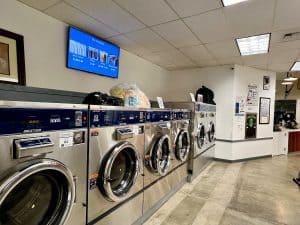
Most retention advice tells you to bribe customers back with points and discounts. I keep customers a different way, and it is harder to copy than any loyalty app.
Search “laundromat customer retention” and you will get the same answer fifty times: start a punch card, launch a points app, run a subscription, send a birthday discount. Almost all of it is written by companies selling loyalty software, and almost none of it is written by someone who actually runs a store.
I run a full-service laundromat and cafe in Everett, Washington. We have 644 Google reviews at 4.9 stars, and a large share of our revenue comes from customers who keep coming back: weekly wash and fold, recurring pickup and delivery, dry cleaning regulars, and commercial accounts that renew. I do use a small loyalty discount. But the discount is not what keeps people. The operation is.
Here is the core idea, and it runs against most of the advice out there: a discount can be copied by the laundromat down the road in an afternoon. An operation that customers trust and actually like cannot. If your whole retention strategy is “be cheaper or give points,” you are competing on the one thing any competitor can match tomorrow. This guide is about the things they cannot match.
Why retention matters more than the next new customer
Getting found is expensive and slow. You optimize your Google Business Profile, you build reviews, you run pickup and delivery into new cities, all to earn a first visit. If that first visit does not turn into a second, you paid for a stranger who never comes back.
A retained customer is the opposite. They cost nothing to re-acquire. They use more services over time: the self-service customer becomes a wash and fold customer, the wash and fold customer adds dry cleaning, the dry cleaning customer refers their office. And they are the people who leave the reviews that bring in the next stranger. Retention is not a separate project from growth. It is the engine underneath it.
So the question is not “how do I get more new customers.” It is “why would the customers I already have ever go anywhere else.” Everything below is an answer to that second question.
The discount I run, and why it is the smallest part
I will start with the loyalty piece, because it is the part everyone expects, and then explain why it does the least work.
We give 10% off to customers who pay through our machine payment app, and 10% off recurring pickup and delivery orders. I frame the app discount the way customers actually feel it: roughly a free wash for every ten. That framing matters. “10% off” is abstract. “Your tenth wash is on us” is something a person can picture. We started lower and raised it once we saw it move behavior, the discount is real money, so it should be doing real work.
For commercial accounts, we use never-expiring volume discounts that reward bigger orders. The point is not the exact percentage. It is the structure: the more they consolidate with us, the better their rate, and it never resets, so there is no reason to shop around or split their laundry across vendors.
Here is the honest part. The discount gets people to choose the app and to consolidate orders. It does not, by itself, make anyone loyal. If the only reason someone uses my store is the 10%, a competitor offering 15% takes them. The discount is the floor. Everything else in this guide is the building.
The cafe: the one thing they cannot copy
No other laundromat near me has a cafe. That single fact is one of my best retention tools, and it is structurally impossible for most competitors to match.
Here is how I use it. When I notice someone has run a big session, several large loads, real money through the machines, I bring them a free coffee, a cold bottled water, sometimes a soda. It costs me about a quarter wholesale. The effect on the customer is wildly out of proportion to that quarter. Two free bottles of water on a hot afternoon, handed to someone who just spent an hour doing laundry, does something a coupon never does: it feels like being taken care of, not marketed to.
One detail I am deliberate about: I do not hand out the cheapest possible product. We run a premium store, and a bottom-shelf bottle would quietly undercut that. The free item still has to feel like something you would actually want. The goal is generosity that reinforces the brand, not a giveaway that cheapens it.
We also keep free candy for kids. Bulk cost is almost nothing, but we buy a name brand, not the cheapest option, for the same reason. A parent doing laundry with a restless kid is one of your most stressed customers. A bowl of candy and a kids corner turns that visit from something they dread into something manageable. They remember which laundromat made their Saturday easier.
If you do not have a cafe, you can still apply the principle. A pot of coffee, a small cooler of water, candy for kids, these cost almost nothing and signal that you see the person, not just the transaction. The structural advantage of a full cafe is hard to copy. The instinct behind it is available to anyone.
Knowing people by name is the whole game
If I had to keep only one retention tactic, it would be this one, and it is free.
We know our regulars by name. “Good morning, John.” “Hi Sally, how is your mother doing?” We ask about their kids, their week, the thing they mentioned last time. This is not a script. It is the actual relationship you build with people who walk into your store every week.
Here is why it beats any app. A points balance lives in software. A relationship lives in a person. When a customer is deciding whether to drive past your store to the new place that just opened, the points are easy to walk away from. The fact that you ask about their daughter’s soccer team is not. You have made yourself part of their week, not just a vendor of clean clothes.
This is the part most operators skip because it does not feel like “marketing.” It is the most powerful marketing in the building. Train your staff to learn names. Greet people. Remember one real detail about the regulars. It costs nothing and it is the single hardest thing for a competitor to replicate, because they would have to rebuild every relationship from zero.
The small touches on every wash and fold order
For wash and fold, pickup and delivery, and dry cleaning, the service itself is the baseline. What keeps people is what happens around it.
A few things we do on every order:
- A personally signed card goes in every wash and fold order, and a signed tag goes on every dry cleaning order on the hanger. It takes seconds. It tells the customer a real person handled their clothes, not a faceless machine.
- We carry the load to the car. On pickup, we take the laundry out. On delivery and at the counter, we walk the cart out to their car. A basket of wet-heavy laundry is genuinely hard to carry. Doing it for them is a small thing that lands almost every time.
- We follow up by text after the order. A short, human message thanking them and asking how it went. Not a survey blast. A real check-in. It tells them we care whether the work was right, and it gives an unhappy customer a private place to tell us before they tell Google.
None of this is expensive. A card, a tag, a walk to the parking lot, a text. Together they turn a commodity service into something that feels personal, and personal is what people come back for.
How I handle it when something goes wrong
Most retention is lost in the moment something goes wrong. A lost sock, a late delivery, a stain that did not come out. How you handle that moment decides whether the customer tells everyone they know to avoid you, or tells everyone you are the place that makes things right.
My rules are simple and generous on purpose:
- Lost or damaged items, in wash and fold or dry cleaning: we reimburse at ten times the cost of the item, or the cost of a new replacement, whichever is less. That sounds expensive. In practice we plan for about one payout a month and treat it as a normal cost of doing business. Some months there are none. When there is one, that customer becomes a believer instead of a one-star review, and the payout is a fraction of the reputation damage it prevents.
- A late or unhappy order gets a full refund. No negotiation, no defensiveness. If we did not deliver what we promised, the customer should not pay for it.
- If we find an item left behind, we hold it and chase the customer down. We call and text to get it back to them. People do not expect that. A customer who assumed something was gone forever, and then gets it back because you went looking, usually stays a customer for a long time.
The instinct in a service business is to protect margin in these moments. I think that is backwards. The customer who has a problem solved generously is more loyal than the customer who never had a problem at all. Service recovery is not a cost center. It is one of the highest-return things you can do.
Cleaning in front of customers, on purpose
Most owners clean after closing so customers never see the mess. I do the opposite on purpose. I want customers to see the cleaning happen.
This is different from hiding a breakdown. A broken machine is a failure signal, so I never advertise it: no out-of-order signs, no visible problems. Routine cleaning is the opposite. It is care, and care is exactly what you want customers to see.
When someone washes a pet item like a dog bed, we run a sanitizing cycle with baking powder on that machine right after, in view, so the next person gets a clean drum. In the last hour of the day, while customers are still on the dryers, we wipe down and clean all the machines. We clean lint trays in front of people. We wipe and dust unused machines. We clear the stuck detergent residue out of the dispenser compartments, the same residue customers tell us is caked solid at other laundromats. When something spills or a bit of dirt falls out of a pocket, we clean the floor right away, not later.
Doing it in the open changes what the customer believes about every machine in the building. They are not just told the store is clean. They watched it happen. That is the difference between a claim and proof.
We also manage the air. Twice a day we open the front and back doors to move fresh air through, and a whole-house fan pulls air up and out. A laundromat that smells fresh instead of damp is a laundromat people are comfortable spending an hour in. Smell is one of those things nobody compliments but everybody notices.
I wrote more about why a spotless, well-run store is the foundation for everything else, including raising prices without losing anyone, in my guide on raising laundromat prices without losing customers. The clean store and the loyal customer are the same project.
The automated follow-up system behind it
The relationship work is human and cannot be automated. But the reminders and follow-ups can be, and should be, because relying on memory means they do not happen consistently.
I use my point-of-sale system, Cents, to run a set of automated text journeys triggered by customer behavior. The ones that matter most:
- A first-visit follow-up that thanks a new customer and asks for a review while the experience is fresh.
- A new-customer win-back that nudges someone who came once but has not returned, before they drift away for good.
- Service-specific re-engagement for dry cleaning and for wash and fold or pickup and delivery, so a lapsed customer in each service gets a relevant reminder instead of a generic one.
- A lapsed-customer drip for anyone who has not ordered in a while, to bring them back before the gap becomes permanent.
The principle: automate the timing, keep the message human. The system makes sure no customer slips through the cracks because someone forgot to follow up. The follow-up itself still reads like it came from a person, because it did, I wrote it once and let the trigger handle the when.
This is also where retention feeds your reviews. The first-visit follow-up is how a steady stream of fresh reviews gets built, which is the foundation of getting found in the first place. I covered the review system and the rest of the local-visibility work in my Google Business Profile guide for laundromats.
Retaining commercial accounts
Commercial accounts retain differently from walk-in customers, because the relationship is with a business that has a budget and a schedule, not a person doing their weekly laundry.
What keeps them is reliability above everything: their towels back when promised, every time, because their business depends on it. On top of that, we use never-expiring volume discounts that reward larger orders, so consolidating with us always beats splitting their laundry across vendors. And we offer invoice terms, net 15 and net 30, the way a real vendor does, so working with us feels like working with a business, not a laundromat doing commercial on the side.
I went deep on finding, pricing, and keeping commercial clients in my guide on landing small commercial laundry accounts. For retention specifically, the rule is the same as the rest of this article: be the vendor they trust, and price so leaving makes no sense.
The retention checklist for laundromat owners
If you want to keep more of the customers you already have, here is the practical sequence, cheapest and highest-impact first:
- Learn your regulars’ names and use them. Free, and the hardest thing for a competitor to copy. Start today.
- Give something small and genuine. Coffee, water, candy for kids. A quarter of cost, an outsized return. Make it feel premium, not cheap.
- Add a human touch to every order. A signed card or tag, carrying the load to the car. Seconds of effort, real impact.
- Follow up by text after every order. Thank them, ask how it went, catch problems privately before they go public.
- Be generous when something goes wrong. Refund the unhappy order. Reimburse the lost item without a fight. Chase down what was left behind.
- Clean where customers can see it. Make the cleanliness visible. Manage the smell of the place.
- Automate the timing, not the relationship. Use your point-of-sale tools to trigger follow-ups and win-backs so nobody slips through, but keep the message human.
- Use a discount as a floor, not a strategy. A loyalty rate is fine. Just do not mistake it for the reason people stay.
Frequently asked questions
Do I need a loyalty program to retain laundromat customers?
No. A small loyalty discount can help nudge behavior, like getting customers onto your payment app or consolidating commercial orders, but it is the weakest part of retention. What actually keeps customers is a clean store, genuine service, knowing people by name, and handling problems generously. A discount can be matched by any competitor. A trusted operation cannot.
What is the cheapest way to improve laundromat customer retention?
Learning your regular customers’ names and greeting them personally. It costs nothing and it is the single hardest thing for a competitor to replicate, because they would have to rebuild every relationship from scratch. After that, small genuine touches: free coffee or water, a signed card with each order, carrying the load to the car.
How should I handle a lost or damaged item?
Generously and immediately. In our store, for wash and fold and dry cleaning, we reimburse at ten times the item’s cost or the price of a replacement, whichever is less, and a late or unhappy order gets a full refund. We plan for about one payout a month as a normal cost of doing business, so it never feels like a crisis. A problem solved generously creates a more loyal customer than one who never had a problem. Defensiveness in that moment is what loses customers, not the mistake itself.
Should I clean my laundromat while customers are there or after hours?
While they are there, at least some of it. Cleaning in view turns a claim (“we keep it clean”) into proof customers actually witnessed. Wipe machines, clear lint trays, clean spills immediately, and manage the air so the place smells fresh. Customers trust a store more when they have seen the work happen.
How do I bring back customers who have stopped coming?
Use your point-of-sale system to trigger automated win-back texts for customers who have not ordered in a while, before the gap becomes permanent. Keep the message human and specific to the service they used. But the better answer is to not lose them in the first place, most lapsed customers leave after a bad experience that was handled poorly, not because of price.
Does a loyalty discount hurt my margins?
Only if it is your whole strategy. A modest discount that moves real behavior, like getting customers onto your app or growing commercial order size, pays for itself. The mistake is competing on discount alone, which trains customers to leave the moment someone offers a bigger one. Build loyalty on service and use the discount as a small nudge, not the main event.
How do I keep commercial laundry accounts from leaving?
Reliability first: deliver exactly when promised, every time, because their business depends on it. Then make staying the easy choice with never-expiring volume discounts that reward larger orders, and offer real invoice terms like net 15 and net 30. When you are reliable and consolidating with you saves them money, there is no reason to shop around.
What comes next
Retention is the engine under everything else. It makes your marketing cheaper, your reviews steadier, and your revenue more predictable. But it sits on top of two other foundations: getting found, and pricing right.
If you haven’t read them yet:
- Google Business Profile for Laundromats, the foundation for getting found locally and building the reviews retention feeds.
- How to Raise Laundromat Prices Without Losing Customers, why a store worth coming back to is also a store you can charge more for.
- How to Land Small Commercial Laundry Accounts for Your Laundromat, finding, pricing, and keeping the accounts that renew.
Daniel owns and operates Bims Laundry Cafe in Everett, Washington, serving customers across 14 cities in Snohomish County and King County with wash and fold, pickup and delivery, commercial laundry, event linen, dry cleaning, and an on-site cafe. Every tactic in this guide is something we actually do in the store, not theory.