Self-service raised three times. Dry cleaning five. Pickup and delivery twice. Almost no pushback. Here’s exactly how I did it, with real numbers.
Last updated: June 2026
Over two years, I’ve raised prices across every service line in my store: self-service machines three times, wash and fold once, pickup and delivery twice, dry cleaning five times, cafe twice, and commercial accounts on renewal. The result: revenue went up and we saw almost no pushback.
That’s not because I got lucky. It’s because most laundromat owners think about pricing wrong. They treat a price increase like a single scary event. They agonize over it for months, finally raise everything at once, and then hold their breath waiting for the backlash.
I treat pricing as an ongoing part of operating the business, the same way I think about machine maintenance or staffing. You don’t wait until three machines break to start fixing things. You shouldn’t wait until your margins are underwater to adjust your prices.
This guide covers the exact pricing decisions I’ve made at my store: which services I raised, by how much, in what order, and what happened with customers when I did. I’ll also explain the one thing that matters more than how you communicate a price increase, and it has nothing to do with signage or emails.
The short version: Fix the store experience first, then raise prices where customers are least price-sensitive: large machines, specialty dry cleaning, pickup and delivery. Keep one entry price below every competitor, end every price in 8, stagger increases over months, and never apologize. Done this way, you can raise prices on every service line with almost no pushback.
The real reason price increases fail
Most pricing advice for laundromats focuses on tactics: raise gradually, post a sign two weeks before, offer a loyalty discount to soften the blow.
That’s not wrong, but it misses the point. Price increases fail when the customer’s only relationship with your store is the price. If the only reason someone comes to your laundromat is because you’re the cheapest option within two miles, then yes, any increase will push them to the next cheapest option.
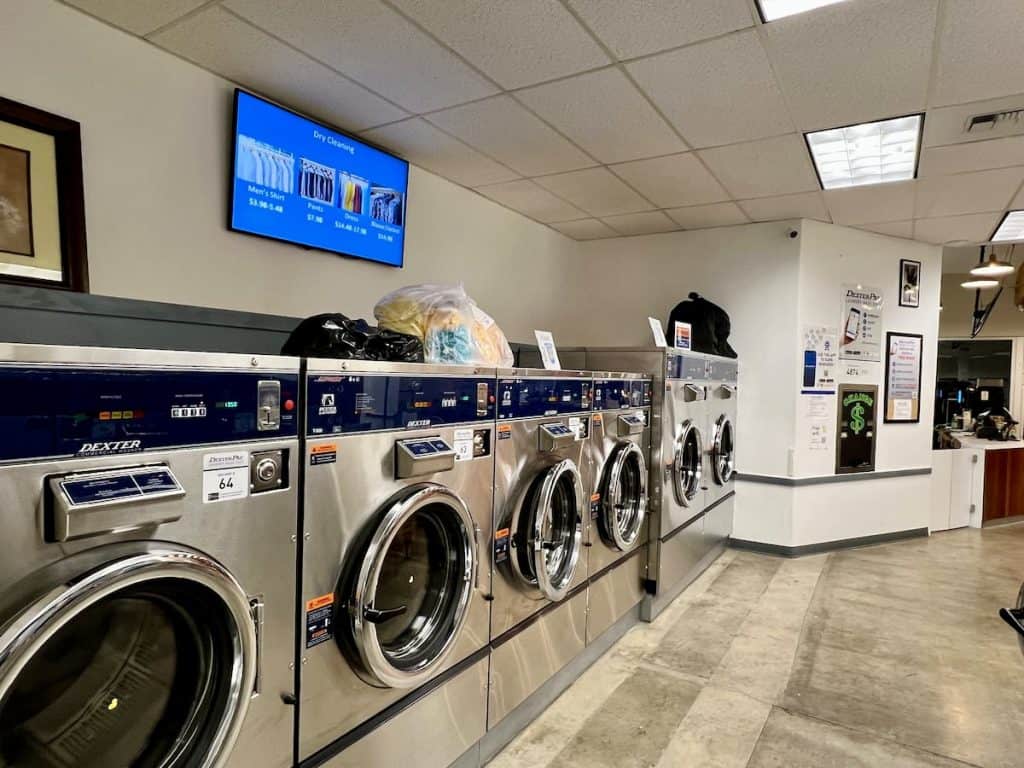
The owners who raise prices without losing customers are the ones who’ve built a store worth paying more for. Clean machines, good lighting, a pleasant environment, staff who actually acknowledge people. The price becomes one factor among many instead of the only factor.
I work Sundays. I say hello to customers. I ask about their day. I thank them when they leave. I give kids free candy. It costs a quarter, but it keeps them happy at the kids corner while their parents do laundry. We have a cafe on site. The store is clean. The machines work. We’re fully attended, and the bathrooms are kept spotless and locked for customer use only. We’ve had customers tell us our bathrooms are cleaner than the LA Fitness next door. Families and women especially notice that, and they come back because of it.
None of that is complicated. But it builds enough goodwill that when the vend price goes up by fifty cents, customers don’t notice or don’t care. They’re not just paying for a wash cycle. They’re paying for the experience of doing laundry in a place that doesn’t feel miserable.
If your store is dark, your machines are unreliable, and nobody on staff makes eye contact, fix that before you raise prices. The experience is the pricing moat.
Early on, I made a deliberate decision: we compete on quality and service, not on price. Every business has three levers: price, quality, and service. The reality is you can only win on two. If you try to be the cheapest, the cleanest, and the fastest all at once, you’ll burn through your margins and deliver mediocre everything.
I chose quality and service. That means our prices aren’t the lowest in the area, and that’s by design. That single decision is what makes every price increase possible. When customers choose you for the experience, they stay for the experience. Price becomes background noise.
What does quality actually look like in a laundromat? Every machine is wiped down and cleaned daily. We run sanitizing cycles with baking soda at the end of each day so machines are clean and ready the next morning. All detergent dispensers are cleaned of dried powder. Customers tell us competitor dispensers are caked with old detergent stuck in them. A handyman power washes the drains and drain troughs monthly. We even cleaned and coated all the drain pipes so debris slides out instead of clogging, a problem we noticed early on and fixed permanently.
No machine ever has an “out of order” sign on it. An out-of-order sign is a public admission of a problem, and worse, it’s a photo opportunity. A customer snaps a picture, posts it to a Google review or a local Facebook group, and suddenly that sign is your store’s first impression for anyone who sees it. Instead, if a machine goes down, we fill it with clothes or drape a linen over it so it looks like it’s in use, then work with the vendor to get it resolved fast. Every machine is under a support contract. Customers walk in and see a full floor of clean, working machines. They never see the maintenance. They just experience a store where everything works.
That’s the quality side. It costs time and attention. But it’s why a 50-cent price increase doesn’t cause a single complaint.
How I structure pricing across services
Not all services have the same price sensitivity. Understanding which customers care about price and which don’t is the key to raising revenue without creating friction.
Here’s how I think about it:
Self-service machines: anchor low, maximize high
The small machines, 20lb and 30lb, are where your most price-sensitive customers live. These are the customers doing basic weekly laundry who have a mental budget for what a load should cost. They’re the ones most likely to notice an increase and most likely to compare you to the store down the road.
My approach: keep the lowest-priced machine lower than every competitor. Our entry-level machine starts at $5.50. That lets me honestly say we have the lowest starting price in the area.
On the other end, the 60lb and 90lb machines? Almost zero price sensitivity. These are typically used by people who have washers and dryers at home but need a bigger machine for comforters, bedding, and oversized items. They’re not comparing your price to other laundromats. They’re comparing it to the inconvenience of not washing their comforter at all.
Our 90lb machines are priced at $20 for cold, $21 for warm, and $21.50 for hot. Temperature-based tiering. Most laundromats charge a flat rate per machine size. We extract additional revenue per cycle based on a feature the customer self-selects. So far, nobody has complained about the temperature-based pricing.
The principle: anchor your entry price low enough to claim the “affordable” position, then maximize margin on the machines where customers aren’t comparing.
Wash and fold: separate drop-off from pickup and delivery
We started wash and fold at $2.28 per pound, same rate for drop-off and pickup and delivery. In month two, we raised both to $2.38 per pound.
A month later, we made a smarter move. Instead of keeping pickup and delivery at the same price as drop-off, we raised it to $2.68 per pound, but offered free delivery based on distance from the store, with minimums.
That reframing changed everything. At $2.38 plus a separate delivery fee, customers saw two charges and felt nickel-and-dimed. At $2.68 with free delivery, they saw one price and a benefit. Customers love free delivery. The per-pound increase more than covers the delivery cost, but the psychology is completely different. They feel like they’re getting something instead of paying extra for it.
Dry cleaning: protect the staples, raise the luxury items
This is where the most interesting pricing psychology happens. We’ve raised dry cleaning prices five times.
The strategy: keep the bread-and-butter items, laundered shirts and dress shirts, priced lower than every competitor. These are the items customers buy most frequently and are most likely to price-compare. They’re also what gets someone in the door.
Then raise the high-ticket items: jackets, coats, specialty garments. These are purchased less frequently, and customers are far less price-sensitive on them. Dry cleaning is already a luxury service. Someone bringing in a winter coat for cleaning is not shopping around for the best per-garment rate.
The pattern we landed on: every time we raised shirts, we checked every competitor within driving distance and made sure we stayed slightly below the closest one. Shirts went from $3.38 to $4.48 to $5.48, and they’re at $6.48 today. Each of those increases held its position below the nearest competitor at the time. We never raced to the top. We just moved up whenever the gap got wide enough that we were leaving money on the table.
Out of all our dry cleaning customers, only two people noticed or commented on the increases. Both were long-time regulars who remembered the old pricing. Every new customer has no reference point. They just see our current prices and decide if they’re reasonable. And they are: we’re equal to the nearest dry cleaner and lower than the premium one in Mill Creek.
We also offer text notifications at pickup and when the order is ready, plus pickup and delivery for both wash and fold and dry cleaning. That convenience layer makes the pricing almost irrelevant for busy professionals and families.
Commercial accounts: go low to win, raise on renewal
The commercial pricing story is different because you’re dealing with contracts, not walk-in customers.
When a government agency reached out to us for a bid, we priced aggressively low to win the initial contract. The goal was to get in the door and prove we could deliver. The original rate was intentionally below our normal margins. Once we’d demonstrated reliability over the contract period, we raised prices more than 40% on the first option-year renewal, and it was accepted without negotiation. They didn’t shop it around because we’d already proven we could execute. The renewal price wasn’t a windfall. It was a correction to where the pricing should have been all along, now that the risk of working with an unproven vendor was gone.
We also simplified the pricing model. The original contract priced by size: different rates for tablecloths, napkins, and bar towels. On renewal, we moved to a one-price-any-size model. Simpler for us to manage, simpler for the client to understand, and it eliminated the line-item negotiations that eat up time on both sides.
The cafe: raise alongside everything else
We have a cafe on site: coffee, drinks, sandwiches. We raised all drink and coffee prices alongside the laundry increases. No pushback at all. If anything, the cafe is a differentiator that makes every other price increase less noticeable because it changes the perception of what kind of business this is. You’re not just at a laundromat. You’re at a laundry cafe.
The eight-cent pricing rule
Every price in our store ends in 8 cents.
Not .99. Not .95. Not .49. Always .38, .48, .58, .68, .98, and so on.
The deliberate exception is the coin machines. They take quarters, so vend prices have to land on 25-cent multiples: the entry machine’s round $5.50, the 90-pounders at $20 to $21.50. The 8-cent rule applies everywhere we control the exact price: wash and fold, dry cleaning, and the cafe. On the machines, the clean advertised anchor does the same job.
Why: when a competitor prices their wash and fold at $2.49 per pound and we’re at $2.38, the customer sees a bigger gap than the actual 11 cents. We’re a full tier below that .49 threshold. And if another competitor is at $2.39, we’re still lower, by a single penny that looks like an intentional undercut.
Ending in 8 means we’re always sitting just below the next psychological price point competitors tend to land on. This is a small psychological edge, not a magic trick. But across every service and menu item, it adds up to a consistent perception: we’re priced fairly.
What I didn’t do
I didn’t post signs in advance. I didn’t send emails warning customers. I didn’t apologize for the increases. I didn’t offer loyalty discounts to “soften the blow.”
I just changed the prices.
For retail customers, self-service, wash and fold, dry cleaning, the reality is that most people don’t memorize your prices. They remember whether the experience felt fair. If the store is clean, the service is good, and the staff treats them well, a moderate price increase either doesn’t register or doesn’t bother them enough to say anything. And new customers never knew the old price anyway.
For commercial accounts, it’s different. You’re negotiating directly with a person who has a budget. There, the conversation is about value delivered: reliability, turnaround, consistency. If you’ve proven those over a contract period, the renewal conversation is about continuing the relationship, not about the lowest possible per-unit cost.
The actual timeline
I didn’t raise everything at once. Here’s how it played out across our first 24 months of ownership:
Month 1: No changes. We wanted a full month of operating the business before touching anything, partly to understand what we’d actually bought, partly so any changes we made couldn’t be blamed on “the new owner who raised prices on day one.”
Month 2: First full round across every service. Self-service machines, wash and fold ($2.28 → $2.38), pickup and delivery ($2.28 → $2.38), dry cleaning (menu update, everything except shirts, which we held as the anchor), and cafe (everything). Many of these were corrections. The previous owner had let prices drift below market. This round was less about strategy and more about catching up.
Month 3: Pickup and delivery only. Moved from $2.38 to $2.68 with free delivery. This was the reframing move, separating P&D pricing from drop-off wash and fold.
Month 6 (January 2024): Second full round. Self-service increase #2 and another dry cleaning menu update, still holding shirts. New year, clean pricing reset.
Month 9: Dry cleaning partial. Coats, jackets, and shirts only. We left everything else where it was and raised only the items that were furthest below the market.
Month 12: Self-service increase #3, dry cleaning shirts and pants raised, and the cafe drinks went up (coffee, tea, soda).
Month 23: Dry cleaning shirts and pants again. This is the increase that took shirts to their current $6.48.
The staggering matters because it limits the number of changes any single customer notices at once. Someone who uses self-service and occasionally drops off dry cleaning might experience two increases across a full year, each one small enough to be unremarkable.
It also matters because it lets you learn between rounds. If an increase generated any friction, you’d know before the next one went into effect. We never had that friction, which is what gave us the confidence to keep going.
Which customers you’ll lose (and why that’s fine)
When I raised the small machine prices, we probably lost a few customers. These are the pure price shoppers, people who will drive an extra mile to save a quarter per load.
Let them go.
There are two laundromats nearby with lower prices than us on small machines. One is in a bad neighborhood. The other has no amenities. If someone’s sole decision factor is the absolute cheapest vend price, they were never going to be a profitable long-term customer anyway. They’re not using your wash and fold. They’re not bringing in dry cleaning. They’re not ordering pickup and delivery. They’re often occupying machines during peak hours without contributing enough revenue to justify the space.
The customers you want to keep, and attract more of, are the ones who value the experience, use multiple services, and aren’t making their decision over a quarter. Those customers subsidize your ability to keep the entry-level price low while building the business on the higher-margin services.
The pricing checklist for laundromat owners
If you’re about to raise prices for the first time, or if you’ve been avoiding it, here’s the practical sequence:
- Fix the experience first. Clean the store. Fix broken machines. Make sure staff acknowledges customers. You can’t charge more for a worse experience.
- Know your competitors’ prices. Visit every laundromat within 3 to 5 miles. Note their prices by machine size. Identify where you’re below market, at market, and above market.
- Identify your insensitive segments. Large machines, specialty services, commercial accounts, and anything convenience-driven (pickup and delivery, dry cleaning) can usually absorb increases with minimal friction.
- Keep one anchor low. Your lowest-priced machine or service should be competitive or below market. That’s your marketing claim: “Starting at $X.”
- Raise the insensitive services first. Dry cleaning, large machines, pickup and delivery. Test the water where it’s safest.
- Stagger increases over months. Don’t raise everything on the same day. Spread it out so no single customer experiences a dramatic change.
- Don’t apologize. If your store delivers a good experience, a moderate price increase doesn’t require explanation or justification.
- Revisit every 6 to 12 months. Costs go up. Your prices should too. This isn’t a one-time event. It’s part of running the business.
Frequently asked questions
How much should I raise laundromat prices at one time?
Enough to matter for your margins but not enough to shock customers. In our store, workable increases have typically been in the $0.25 to $0.75 range per machine for vend prices and $0.10 to $0.25 per pound for per-pound services. If you haven’t raised prices in over a year, you may need a larger correction. Just be prepared that the smallest machines might see a few customers leave.
Should I tell customers before I raise prices?
That depends on the service. For self-service machines and walk-in services, I don’t announce increases. Most customers don’t notice. For commercial accounts with contracts, you obviously discuss pricing at renewal. For everything in between, the quality of your store speaks louder than any sign you could post.
How do I know if I’m underpriced?
Visit your competitors. If your prices are lower and your store is cleaner, you’re underpriced. Also look at your margins. If utilities are putting real pressure on your gross revenue, your prices probably aren’t keeping up with your costs.
What if my area has a really cheap competitor?
You don’t have to be the cheapest on every machine. Keep your entry-level price competitive and differentiate on experience, services, and convenience. The customer choosing a store solely on price is rarely the customer who drives long-term profitability.
Won’t raising prices hurt my Google reviews?
In two years and multiple rounds of price increases across every service, we’ve had one review mention pricing out of 650+. It was from a first-time customer who came in after our increases, not a regular who left because prices went up. That’s going to happen when you don’t compete on price. The customers who left because they wanted the cheapest option never left a review. They just quietly stopped coming. No regular customer has ever complained about a price increase in a review. When the store experience is strong, price increases rarely generate complaints. Bad experiences generate complaints.
How often should laundromat prices be reviewed?
Every 6 to 12 months at minimum. Costs don’t stay flat. Your prices shouldn’t either.
What’s the best pricing structure for wash and fold?
Per pound with a minimum. We charge $2.38/lb for drop-off and $2.68/lb for pickup and delivery with free delivery based on distance. The higher per-pound rate absorbs the delivery cost, but customers respond better to “free delivery” than to a lower rate plus a separate delivery fee. The psychology matters more than the math.
What comes next
Pricing is one lever. The other big ones are getting more customers to your store, keeping the ones you have, and building revenue streams that don’t depend on walk-in traffic. That’s where your Google Business Profile, your local SEO, your review system, and your commercial accounts come in.
If you haven’t read them yet:
- Google Business Profile for Laundromats, the foundation for getting found locally
- How to Land Small Commercial Laundry Accounts for Your Laundromat, how I built a commercial laundry line from one location
- How to Keep Laundromat Customers Coming Back, why the store experience that lets you raise prices is the same one that keeps people